From Product Conversations to System Impact
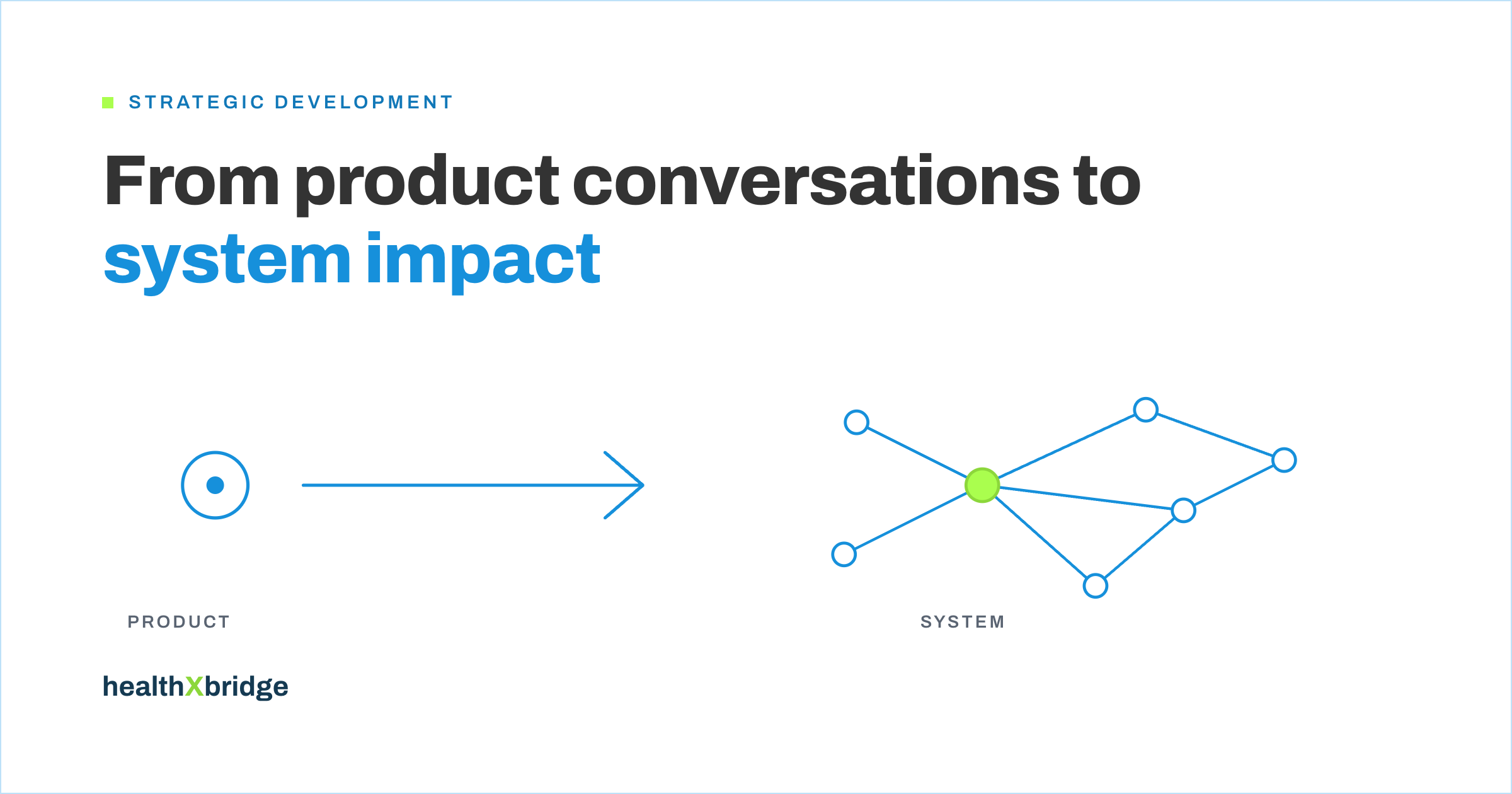
Rethinking how pharma engages healthcare systems
Across life sciences, there is a growing recognition that traditional commercial and medical models are no longer sufficient.
Healthcare systems are under unprecedented pressure. Clinicians are overloaded. Pathways are fragmented. Decision-making is increasingly collective, local, and shaped by system priorities rather than individual preference. Yet many pharma teams are still trained primarily to engage around products, data, and messages, rather than around how care is actually delivered.
At healthXbridge, we are designing strategic development programmes that help commercial and medical teams fundamentally shift how they engage with healthcare systems, moving from transactional conversations to system-level impact.
The problem we see repeatedly
Most pharma teams are highly capable in scientific exchange. They understand their data, their evidence, and their value propositions. Where challenges arise is in translating that capability into real-world patient access.
Common symptoms include:
- Teams unsure who truly influences access decisions
- Limited visibility of how patient pathways really operate
- Strong engagement with clinicians, but little impact on flow, follow-up, or treatment sequencing
- Frustration that “the system” is the barrier, without clarity on how to work with it
This isn’t a capability issue in the traditional sense. It’s a system understanding gap.
A different starting point: the healthcare system itself
Our development programmes start from a different premise: if you want sustainable access and long-term value, you must understand, and engage with, the healthcare system as it actually functions.
That means helping teams to:
- Understand commissioning, funding, and service design, not just clinical guidelines
- See where patient pathways break down and why
- Identify who owns problems versus who feels their consequences
- Recognise how clinicians operate within system constraints, not outside them
This shifts the conversation from “how do I present my data?” to “how do I help this system work better for patients, and where does our medicine fit?”
What we build capability around
Rather than delivering generic training, we design bespoke, system-led development programmes that focus on:
System literacy — how healthcare systems make decisions, allocate resources, and prioritise change
Patient pathway insight — understanding real-world flow, leakage points, and delays, not theoretical pathways
Stakeholder strategy — knowing who truly influences access, beyond job titles or organisational charts
Ethical solution co-creation — working with clinicians and system leaders to design compliant, sustainable improvements
Medical–commercial alignment — creating shared understanding of system goals, roles, and contribution
The outcome is teams that can engage clinicians not just as prescribers, but as partners operating inside complex systems.
Why this matters for sustainability
For pharma companies, sustainability increasingly depends on:
- Being credible contributors to system priorities
- Supporting earlier diagnosis and appropriate treatment
- Demonstrating value beyond the molecule
- Building long-term partnerships, not short-term wins
Teams that understand how clinicians navigate pressure, incentives, and constraints are far better positioned to create that value, ethically and compliantly.
This is not about doing more activity. It’s about doing different work, earlier, and with greater system intelligence.
A shift worth making
The organisations that will succeed in the next decade are those that invest in helping their people think systemically, engage strategically and translate insight into real-world patient impact.
At healthXbridge, our philosophy is simple: we don’t train people in theory. We help them change systems.